How an ERP Helped Secure the Management of a Multi-Store Retail Business and Reduce Losses
When Managing Multiple Stores Becomes Difficult to Control
Managing a single store can already be a significant challenge: monitoring sales, managing inventory, purchasing, cash collections, expenses, suppliers, stocktaking, and day-to-day operations.
But when a company operates multiple retail locations, the complexity increases significantly.
Every store generates transactions every day. Every inventory movement needs to be recorded. Every sale needs to be traceable. Every payment needs to be controlled.
Without a centralized management system, a company can quickly lose visibility into what is actually happening across its operations.
This was precisely the situation encountered by one of our clients recently supported by QTA TECH.
The company operated several stores and was facing several challenges:
- cash and inventory discrepancies;
- losses that were difficult to explain;
- limited visibility across its different stores;
- largely manual management of sales, inventory, and purchasing;
- difficulties identifying the source of certain discrepancies;
- limited traceability of operations performed by different employees.
The problem was therefore not simply an IT issue.
It was fundamentally a problem of operational control and business governance.
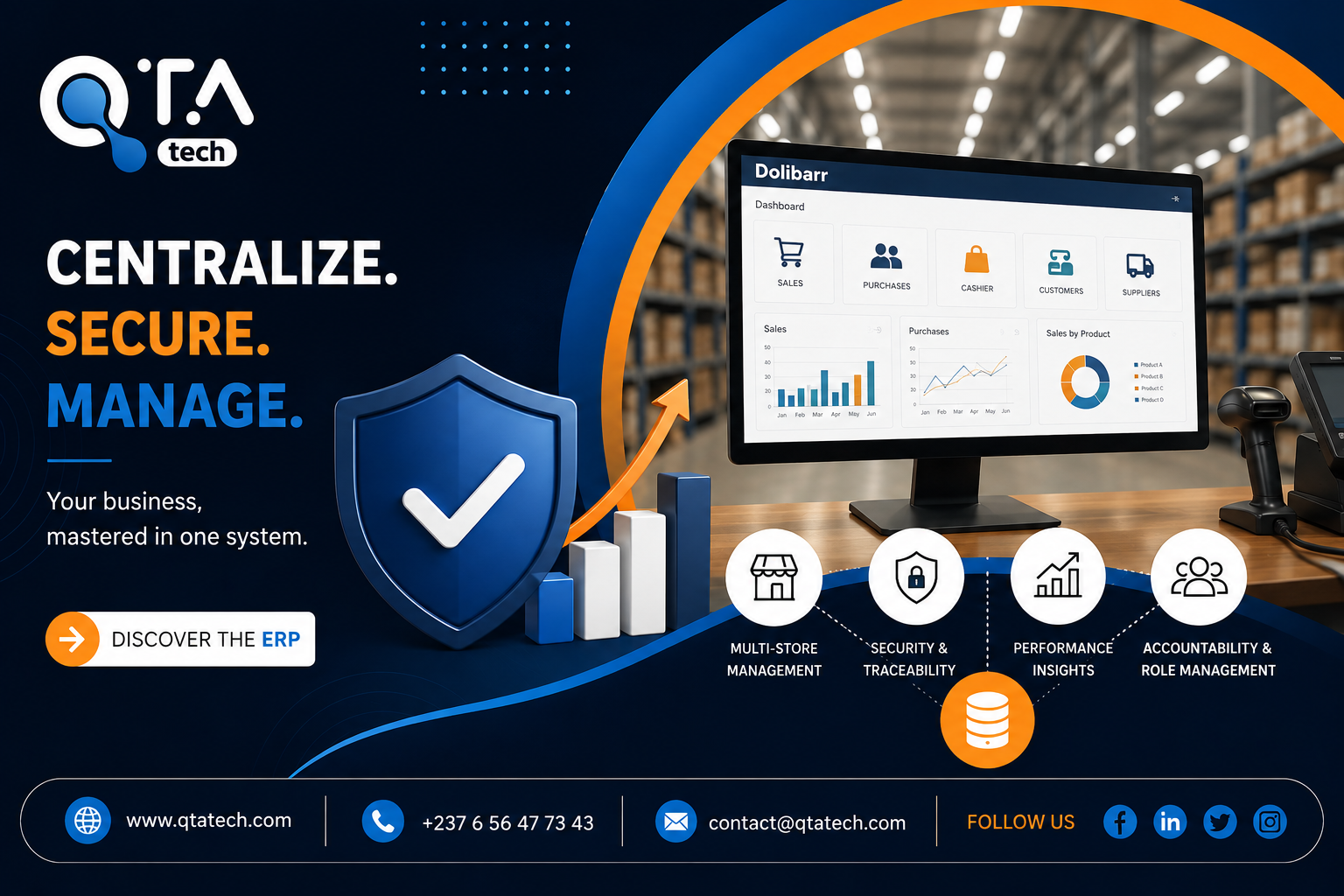
This is where QTA TECH stepped in, deploying and configuring Dolibarr ERP/CRM v23 according to the company's specific operational requirements.
The Real Problem: Managing Multiple Stores Without Losing Control
As a company grows, its management methods must evolve with it.
A system based on notebooks, Excel spreadsheets, separate applications, or manually communicated information may work for a certain period of time.
But as the number of stores, employees, products, and transactions increases, the risks increase as well.
Information Becomes Fragmented
One store has its own sales records.
Another has its own inventory.
Purchases may be tracked in another spreadsheet.
Management may receive different reports depending on who prepared them.
And when a discrepancy appears, it becomes difficult to answer basic but critical questions:
Who performed the operation?
When was it performed?
Which store was involved?
Which product was concerned?
What quantity was recorded?
What was the expected inventory level?
What was actually available?
Without sufficient traceability, control becomes largely dependent on declarations and manual verification.
And when a company suspects theft or unexplained losses, this situation becomes particularly problematic.
Our Approach: Not Just Installing Software, but Structuring the Management System
At QTA TECH, we do not consider an ERP to be simply a piece of software installed on a server.
An ERP must be designed around the actual way a company operates.
Our intervention therefore began by identifying existing processes and the key control points required by the business.
The objective was clear:
Centralize information, secure operations, and give management a reliable view of the business.
To achieve this objective, we deployed and configured Dolibarr ERP/CRM v23.
Dolibarr makes it possible to bring together various essential business processes within a single platform, including products, customers, suppliers, sales, purchasing, inventory, invoicing, users, and other management functions.
However, the real value of the project does not lie solely in installing Dolibarr.
It lies primarily in configuring the platform according to the client's business processes.
1. Centralizing Operations Across Multiple Stores
The first step was to move away from a model in which each store operates as an isolated entity.
The ERP becomes a central management platform.
Each operation can be associated with its relevant context:
- store concerned;
- user responsible;
- product concerned;
- quantity;
- transaction;
- date;
- inventory movement;
- customer or supplier, where applicable.
Management can therefore obtain a consolidated view of business activity.
Instead of requesting information separately from each store, management has access to a centralized system where the required information can be retrieved.
The Change Is Significant
Before:
Store A → spreadsheets / notebooks
Store B → spreadsheets / notebooks
Store C → spreadsheets / notebooks
Management → manual consolidation
After:
Stores → Centralized ERP → Management
The objective is not simply to save time.
It is primarily to reduce blind spots within the organization.
2. Improving Operational Traceability
When a company experiences inventory or cash discrepancies, one question always comes up:
How can we determine where the discrepancy came from?
This is where traceability becomes essential.
An ERP makes it possible to associate operations with users and the relevant business processes.
A structured management system can therefore improve the monitoring of events such as:
- sales creation;
- information updates;
- inventory movements;
- goods received;
- goods issued;
- purchasing operations;
- invoicing;
- user activities.
This traceability does not mean that an ERP will automatically prevent theft.
It would be incorrect to present it that way.
However, a properly configured ERP can reduce opportunities for uncontrolled manipulation and make it significantly easier to identify and investigate anomalies.
This distinction is fundamental.
Technology does not replace internal controls.
It strengthens them.
3. Securing Inventory Management
Inventory is often one of the most important operational assets of a retail business.
When multiple stores are involved, inventory management becomes even more challenging.
Without a centralized system, it can become difficult to quickly determine:
- available stock;
- incoming stock;
- outgoing stock;
- inventory movements;
- replenishment requirements;
- discrepancies between expected and actual inventory.
With an ERP, inventory movements can be recorded within a structured system.
This creates a much more reliable inventory management process.
System Inventory vs. Physical Inventory
This distinction is important.
The ERP provides the inventory quantity recorded in the system.
Physical stocktaking verifies what actually exists.
Comparing the two makes it possible to identify discrepancies.
When a discrepancy appears, the company has a clear starting point from which to investigate its origin.
4. Giving Management a Consolidated View
One of the most common challenges in multi-site businesses is the lack of visibility.
Management may know that the stores are generating sales.
But it may not have a precise and consolidated view of overall performance.
An ERP changes this approach.
Data is centralized, making it possible to analyze business activity from a broader perspective.
Management can progressively answer questions such as:
- Which store generates the highest sales?
- Which products sell the most?
- Which products need replenishment?
- Where are discrepancies occurring?
- Which users are performing specific operations?
- How are sales evolving?
- What purchases have been made?
- What is the overall inventory position?
Data then becomes a genuine business management tool.
5. Clarifying Responsibilities
In a manual environment, several people may participate in the same operation without it always being clear who did what.
This creates a significant weakness in internal control.
With a properly configured ERP platform, users can be managed individually, with permissions and responsibilities aligned with their roles.
The organization can therefore distinguish between different functions according to its operational requirements:
Management
→ supervision and business oversight.
Store Manager
→ operational management of the assigned store.
Salesperson / Operator
→ authorized sales operations.
Inventory Manager
→ inventory movements and stocktaking activities.
Administration / Accounting
→ administrative and financial operations according to the defined scope.
This separation of responsibilities helps create a more structured organization.
6. Reducing Dependence on Excel Files and Paper-Based Processes
Excel remains an excellent tool.
But Excel is not necessarily an ERP.
When multiple people work simultaneously across several stores, spreadsheets can quickly become difficult to manage.
Organizations may encounter:
- multiple versions of the same file;
- information entered late;
- manual errors;
- difficult consolidation processes;
- unsynchronized data;
- information that is difficult to audit.
An ERP moves business management into a structured platform.
The objective is not necessarily to eliminate every Excel spreadsheet.
The objective is to ensure that the company's primary management system no longer depends on scattered files and manual consolidation.
7. A Transformation That Goes Far Beyond Dolibarr
It would be easy to summarize this project by saying:
"We installed Dolibarr for a client."
But that would miss the most important part.
The project was fundamentally about helping a company transform the way it manages its operations.
We worked across several dimensions:
Processes
Understanding how operations are actually performed.
Organization
Defining roles and responsibilities.
Data
Centralizing and structuring information.
Control
Improving operational traceability.
Technology
Deploying an appropriate ERP platform.
Management
Providing management with better visibility into the business.
This combination is what transforms software into a genuine business management system.
The Main Benefits for the Business
The primary objective of this transformation was to secure operations and reduce losses.
The benefits expected and enabled through centralization include:
Better Visibility
Management has a more structured view of the different stores.
Better Traceability
Operations are recorded within a centralized environment.
Better Inventory Management
Inventory movements can be monitored in a structured manner.
Greater Accountability
Users have roles and permissions aligned with their responsibilities.
Fewer Manual Processes
Business processes can progressively become digital.
Stronger Control
Anomalies become easier to identify and investigate.
Better Decision-Making
Management can rely more heavily on available business data.
ERP: A Solution for SMEs and Growing Businesses
A common misconception still exists:
"ERP systems are only for large companies."
This is no longer necessarily true.
Today, SMEs and African businesses also need systems capable of supporting structured growth.
A company operating several stores, teams, inventory locations, and financial flows cannot rely indefinitely on entirely manual processes.
As a company grows, the cost of poor organization grows with it.
An ERP therefore becomes an investment in operational control and business efficiency.
Why Choose QTA TECH for Your ERP Project?
At QTA TECH, our role is not simply to install an ERP solution.
We support businesses throughout the transformation process.
1. Business Needs Assessment
We begin by understanding how your organization actually operates.
2. Process Mapping
We identify sales, purchasing, inventory, invoicing, production, administrative, or other workflows according to your business model.
3. Solution Selection
We determine the ERP solution that best fits your business environment and constraints.
4. Installation and Configuration
We handle the technical deployment and configuration of the platform.
5. User Management
We define roles, permissions, and access levels.
6. Data Structuring
We organize products, customers, suppliers, inventory, and other required information.
7. Training
We support your employees so that they can effectively adopt and use the solution.
8. Support and Continuous Improvement
An ERP project does not end on the day the software is installed.
Businesses evolve.
Processes evolve.
Requirements evolve.
The system must therefore evolve with the organization.
Your Problem May Not Be a Lack of Software
This is probably one of the key lessons from this project.
When a company experiences losses, inventory discrepancies, or management difficulties, the first reaction may be to look for new software.
But the real question should be:
"Do we have enough visibility and control over our operations?"
If the answer is no, the problem may be organizational, procedural, technological—or all three.
An ERP does not magically fix poor organization.
But a properly designed, configured, and integrated ERP can become a powerful lever for business transformation.
What If Your Business Is Next?
Do you manage multiple stores?
Do you operate several points of sale?
Is your inventory difficult to control?
Are your teams still using multiple spreadsheets to manage the business?
Do you regularly encounter discrepancies without being able to clearly identify their source?
Do you want to centralize your operations and improve management visibility?
It may be time to move to a real ERP management system.
QTA TECH supports businesses in implementing ERP solutions adapted to their specific needs, including assessment, consulting, installation, configuration, security, training, integration, and ongoing support.
The objective is not simply to give you software.
The objective is to give you greater control over your business.
QTA TECH — Digitalize. Centralize. Control. Decide.
We design and deploy digital transformation solutions adapted to the realities of African businesses.
ERP | CRM | Business Applications | Digital Transformation | Cybersecurity | IT Infrastructure
To discuss your ERP project and assess your company's business processes, contact QTA TECH.
Website: https://qtatech.com/en/contact-us
QTA TECH — We think & develop together.